Friday, 11 May 2012

Russia's Economy Enters 2012


Economic growth in Russia should stay dynamic in the first half of this year, but we anticipate that the economy will lose some steam in the second part of the year. Following 4.2% growth in 2011, we think the slowdown will lead to GDP growth of about 3.5% for the full year. Initially, we expect that consumption will be boosted by the increase in military salaries and pensions. Inflation, too, should remain moderate in the first half of the year because the government has postponed regulated tariff hikes on electricity and gas prices to July, allowing inflation to stay below 5%. Consumer lending, which reached an expected double-digit rate last year, should also continue to underpin consumer demand in the first part of 2012.
Later in the year, though, we see growth moderating for several reasons. The Central Bank of Russia (CBR) is likely to curb credit growth in the second part of the year. This is because inflation will likely accelerate again on the back of the July electricity and gas tariff hikes, which in turn will slow growth in consumer demand. The fixed capital investment outlook is equally uncertain. Investment growth accelerated in the second part of 2011 on the back of a rise in corporate profits and bank lending. This trend will continue in the first part of 2012, but is likely to slow in the following 12 months as bank lending becomes tighter and somewhat more expensive.
Russia's external sector will remain highly dependent on the outlook for commodity prices. In our baseline scenario for the world economy, we anticipate that growth in developed markets will bounce back in the second part of 2012 on the back of a recovery in emerging markets, in particular China and Brazil. This would be supportive of Brent oil prices staying above $115 per barrel (/bbl) through the beginning of 2013. We note, however, that the so-called breakeven point for Ural oil prices (the price associated with a balanced budget) has risen every year and currently stands above $120/bbl.
Overall we anticipate that real GDP growth will stabilize at about 3.5% this year before experiencing some acceleration on the back of a more dynamic world economy in 2013 (see chart 1).

Chart 1


Momentum From Last Year Carries The Economy Forward

Russia's economy is entering 2012 on a good footing, after 2011 turned out to be a reasonably strong year on balance, with GDP and industrial production up and unemployment down. GDP reached 4.3%, the same as in 2010, on the back of strong credit growth and a rebound in incomes. The industrial production index (IPI) gained 3.3% in manufacturing and 1.8% in mining and quarrying in December 2011 on the same month of the previous year. Both these IPIs had shown upbeat movement during 2010 and 2011, reflecting the recovery from the slump in 2009. Meanwhile, the unemployment rate declined to 6.1% in December, its lowest level since mid-2008. The federal budget recorded a surplus equal to 0.8% of GDP (after minus 4.0% a year earlier), with an average oil price of $109 per barrel.
Buoyant consumer demand also helped drive strong GDP growth. Retail sales accelerated to a record high for the year, rising 9.5% in the 12 months to December. Meanwhile, retail lending rose by 36% over the 12 months to December. Consumption was underpinned by lower inflation. The Consumer Price Index (CPI) dropped to a record low of 6.1% in the 12 months to December, near the floor of the 6%–7% target band set by the Central Bank of Russia (CBR). Between 2004 and 2010, Russia had the highest inflation rate among the so-called BRIC countries (Brazil, Russia, India, China), but this was no longer the case in 2011, as Russia's inflation ran slightly below that of Brazil. This decrease is due in part to the shift in the CBR's monetary policy to a more flexible exchange rate. This has allowed the CBR to reduce its interventions on foreign exchange markets, which used to be an important driver of money supply growth prior to 2008. Money supply growth declined to about 20% in 2011 (chart 2).

Chart 2


A partial recovery in investment and construction also supported the economy overall in 2011, but in our view will not be sufficient to ease the capacity constraints in Russia's important natural-resource extraction sector. Capital spending in December 2011 was 9% up on the previous December, while construction was up 6.7%. Natural resource extraction currently represents 25% of the entire economy. Exports of fuels and metals typically account for three-quarters of total Russian exports, and the gas and oil sector is responsible for as much as 60% of federal budget receipts. Oil and gas faces significant capacity constraints because of an extended period of insufficient investment following the post-soviet economic transition. Moreover, capacity needed to replace depleted older deposits is typically associated with more difficult geological, logistical, and climatic conditions and hence is far more capital intensive to develop and exploit. Capital expenditures remain heavily concentrated: The total capital expenditures of OAO Gazprom, Russian Railways (JSC), OAO AK Transneft, as well as electric utilities reached 4.1% of GDP in 2011. Investment by those very large companies is also heavily dependent on growth in tariffs set by the government. Year on year, these tariffs can increase at a more or less rapid rate depending on the overall economic and political context: Electricity prices rose 13% in 2011, gas prices 15%, but further hikes in 2012 have been postponed to the second half of the year.
Russia's external sector benefitted from the rise in commodity prices during 2011. Merchandise exports grew at 32.2% year on year to reach $380.1 billion. Of this amount, 65.5% were exports of oil and gas, up from 63.5% in the same period of 2010. While merchandise imports grew at an even faster pace of 34.8% to reach $232.3 billion, this was from a much lower base than exports, so that the merchandise trade surplus widened compared with a year earlier to $147.7 billion, an increase of $32.4 billion. At the same time, the physical volume of energy exports from Russia was apparently little changed from a year earlier. According to data published by RosStat for the first 10 months of 2011, the physical volume of crude oil exports was actually down 4.0%, refined product exports were 1.9% lower, and natural gas exports were up 7.4%. But the received price for crude oil in October was 36.7% higher than in the same month a year earlier, and the price of natural gas was up 25.2%

Capital Outflows Have Intensified On Investment Constraints And Political Uncertainty

In spite of these economic achievements, CBR estimates suggest that the best part of Russia's current account surplus of $101 billion (5.8% of GDP) in 2011 was absorbed by $84 billion of capital outflows. This is the second-largest outflow in the history of modern Russia (chart 3).

Chart 3


This sharp rise in capital outflows is the result of a combination of factors, in our view. First, the global financial crisis and the decrease in risk appetite by international investors has made the refinancing of foreign debt and new borrowings abroad more difficult, putting a cap on capital inflows. Additionally, the increased flexibility of the ruble exchange rate has made portfolio inflows based on carry trade less attractive. Second, outbound investments by Russian banks have been a key contributor to capital outflows since the middle of 2010. According to balance-of-payment data, on a cumulative basis by the end of the second quarter of 2011 foreign banking assets had reached $201 billion (12% of GDP). Of these, about $78 billion were parked in the EU: 34% in the U.K., 18% in Germany, 13% in Austria, and 13% in Cyprus. But interestingly, a good part of the increase in banks' foreign assets corresponds to loans made to Russian corporate borrowers. This is because many large Russian companies (and almost all of the publicly listed ones) have part of their holding structures registered in foreign jurisdictions for legal reasons.
According to VTB Capital, a Russian bank, offshore loans by Russian banks stood at $60 billion as of November 2011. Yet, this observation leads, in turn, to another: that large corporate entities borrow through their foreign entities but decline to repatriate those funds. If they did, it would offset the outflows in the capital account. More generally, this also shows that funds generated by Russian exports are not fully reinvested at home, which seems to reflect a perceived lack of investment opportunities in the domestic economy. Institutional limitations can be seen by investors as disincentives, as the central government continues to influence significantly infrastructure developments via the large state-owned companies. In addition, political uncertainties have increased in the past year as the presidential elections, due in March, were approaching, while more anti-government protests were taking place in Moscow.
Looking forward, it is difficult in our opinion to see what would slow this rise in capital outflows in 2012. The continued increase in net foreign assets could be compensated by higher external borrowing on the back of higher lending rates in the domestic economy. However, we only anticipate a very gradual return to financing conditions more favorable to borrowers on international capital markets. This is because we believe that the sovereign crisis in Europe and the associated hike in bond yields will take time to resolve. Meanwhile, political uncertainties at home will not necessarily disappear immediately after the presidential elections. There will still be many questions relative to the pace at which the new government will be ready to undertake structural reforms.

Monday, 16 January 2012

North Korea economy


North Korea economy: The budget offers no hard numbers, yet again
May 25
– As usual, the main formal
business at the annual meeting on April 7th of the Supreme
People’s Assembly (SPA), North Korea’s rubber-stamp legislature,
was to hear economic and budget reports for 2010, and to approve
the budget for 2011. This was as opaque as ever, with a complete
absence of hard numbers. All that was given were a few
percentages, which–even if true–cannot be interpreted without a
baseline.
Until 2002 aggregate totals were published for public revenue and
expenditure, from which it was possible to calculate some
sectoral figures. However, this ceased from 2003, possibly
because it was difficult or embarrassing to deal with the
devaluation that had accompanied partial reform measures in July
2002. Even with such basic data withheld, North Korea will
neither attract serious foreign investment nor be eligible to
join the World Bank or the IMF. South Korean sources attempt to
fill in the blanks, apparently based on a single real figure
heard some years ago in a radio broadcast. The South’s Ministry
of Unification has put the North’s overall budget for 2011 at
Won567bn, which it equated to US$5.7bn–barely 2% of the South’s
budget of US$268bn for the year.
North Korea’s finance minister, Pak Su-gil, reported that in 2010
revenues were 7.7% higher than in 2009, and also 1.3% above their
planned level. Spending rose by 8.2% year on year and hit 99.9%
of the intended figure. By sector, light industry and agriculture
received allocations 10.9% and 9.4% larger, respectively, than in
2009. Science and technology increased by 8.1%, while
“implementation of the popular policies” (presumably social
services, perhaps including health and education, which were not
otherwise mentioned) received 6% more. Being less than the
average increase, this implies its share of total spending has
fallen.
In a particularly obscure phrase, Pak Su-gil added (as reported
by the KCNA) that spending on “the pilot domains of national
economy, basic industrial domains and capital construction last
year went up 8% and 12.9% respectively over [2009].” What look
like three terms here are presumably two: “the pilot domains of
national economy” are the same as “basic industrial domains”. In
North Korean parlance these sectors are the metal, power and coal
industries, and railway transport.
Confusingly, but in line with tradition, defence spending was
given on a different basis: as a proportion of total expenditure,
at 15.8%. This figure hardly varies from year to year–it is the
same for 2011, which would imply a 8.9% rise in defence spending.
Many observers suspect this is an understatement, with much
military spending hidden under other headings. In January South
Korea’s state-run Korea Institute of Defence Analyses (KIDA)
claimed that the North’s actual military spending in 2009 was
US$8.8bn, or 15 times the official figure of US$570m and
equivalent to one-third of its total gross national income. (The
KIDA figures are compiled on a different basis to that used by
the unification ministry.) Even this higher figure is less than
the South’s military expenditure.
The Northern finance minister’s projections for 2011 were also
obscure. Revenue is slated to increase by 7.5% year on year.
Again switching between different sorts of percentages, Pak
Su-gil said that 83.9% of the total will come from central
finances and 16.1% from local budgets. By sector, the bulk of
revenue–some 78.5%–will derive from transaction taxes and state
enterprise profits. Among lesser sources, “the profits of
co-operative organisations, the fixed-asset depreciation, the
income from real estate rent and social insurance are expected to
swell 3.8%, 1.4%, 0.7% and 0.4% respectively” compared with the
previous year.
The balance of planned spending by sector in 2011 differs
significantly from 2010, although again Pak Su-gil did not point
this out. Overall expenditure is set to rise by 8.9% year on
year. Light industry will get 12.9% more than in 2010 and “a huge
budgetary disbursement will be made for local industry, too”.
Agriculture will receive a 9% increase, and “funds needed for
farming will be provided on a priority basis”. Yet “pilot domains
and basic industries”, essentially comprising heavy industries,
are to get 13.5% more than in 2010. This is despite the fact
that, according to a prominent newspaper editorial earlier in the
year highlighting policy, light industry was supposed to be the
core priority this year.
As in 2010, the largest increase of all, of 15.1%, will be
provided to capital construction. Science and technology will get
10.1% more, to help reach the goals of a five-year plan for state
scientific and technological development, due to end in 2012. No
details of this plan are known; North Korea has announced none of
its economic plans publicly since the last seven-year plan ended
in 1993 with a rare admission that planned targets had not been
met.
In general, the finance minister urged “all domains and units of
the national economy to give full play to the mental power of the
producer masses, economise manpower, materials and funds and cut
down as much as possible non-productive expenditure and thus
carry out the monthly and quarterly plans for budgetary revenue
without fail”. The latter phrase hints at the existence of more
detailed figures, undisclosed publicly. The emphasis on
economising could also suggest tight fiscal constraints–as well
as an appeal to the Communist state’s philosophy of juche, or
self-reliance.
A speech to the legislature by the premier, Choe Yong-rim,
provided little extra background to the budget. Past premier
reports have sometimes given useful detail, if only
descriptively. This time the KCNA reported the premier in barely
100 words. His claims of “signal advances” and “big successes” in
2010 were greeted with scepticism by most external observers.
-0- May/25/2011
North Korea economy: The UN launches an emergency food programme
– On April 29th the UN
Children’s Fund (UNICEF) and the World Food Programme (WFP)
announced a one-year US$200m emergency plan. The scheme aims to
feed people affected by crop losses and a particularly bitter winter. It is unclear how this will be financed. UNICEF hadearlier reported that, having sought US$10m for its work in NorthKorea in 2010, it received only US$ 2m. Undaunted, it has launched a US$20m appeal to fund work in five provinces with the worst malnutrition rates, targeting 165,000 pregnant or breast-feeding women and 400,000 young children as the most vulnerable.The WFP seeks to provide 297,000 tonnes of grain plus 137,000 tonnes of fortified foods. This follows a month-long Rapid Food Security Assessment Mission conducted in February-March 2011 by the same agencies, together with the UN Food and Agriculture Organisation (FAO). The report, which was published in March, warned of the high risk of a food crisis. The state ration system, which provides barely more than one-half the average daily calorific requirement, is due to run out of food in May. In the lean season (May-July) over 6m people, or one-quarter of the population, may need food assistance.
The mission declared that in 2010/11 (November-October)
production of staple foods is likely to reach 4.3m tonnes–some
232,000 tonnes below the estimate made by an earlier mission in
late 2010, owing to the severity of the winter. It noted that the
amount of potato seed in winter storage that has been damaged is
higher than normal, and 2011 spring production will likely be 60%
of the planned level. Meanwhile, production of pickled vegetables
(kimchi) was affected by the heavy rains in August-September
2010. The mission concluded that North Korea would need to import
1.1m tonnes of cereal, but that officials plan to import only
200,000 tonnes at present.
Others are sceptical, for reasons that–despite official
denials–are hard to separate from the wider political stalemate
on the peninsula. The US is said to be mulling over assistance,
despite North Korea’s nuclear obstinacy. The main obstacle is
South Korea, whose hardline government summarily scrapped food
aid in 2008, even before the Northern attacks in 2010. The South
professes to doubt how bad the North’s situation really is,
claiming variously that it holds large grain stockpiles in case
of war, or wants to build up supplies so as to celebrate the
centenary of its founder Kim Il-sung next year with a show of
generosity by his son.
The FAO’s concerns are animal as well as human. On March 24th,
after a joint mission to North Korea with the World Organisation
for Animal Health (OIE), it said that vaccines and other
materials worth US$1m were urgently needed to help to combat
foot-and-mouth disease, which has struck eight out of 13
provinces. This is a modest sum compared with the disaster in
South Korea–a likely source of the North’s epidemic–where since
November 3.5m cattle and pigs have been culled, with losses of
US$2.6bn. Although the worst is now thought to be over, both
Koreas were still reporting fresh outbreaks in April.
The FAO added that North Korea’s veterinary services need
modernising, especially biosecurity measures and improving
laboratory infrastructure and capacity. It tallied the country’s
total livestock population at 577,000 cattle, 2.2m pigs and 3.5m
goats. The latter are an important source of dairy products,
while cattle, besides dairy use, are “a key source of draft
power”. The latter comment highlights how farming, once
mechanised, has regressed since access to cheap oil ended with
the collapse of the former Soviet Union. Meat is now a rarity in
North Koreans’ diets, reserved only for special occasions.
-0- May/25/2011
North Korea economy: Trade with China and South Korea rose in 2010
The Korea International
Trade Association (KITA), a private-sector body based in the
South Korean capital, Seoul, in March published a comparison of
North Korea’s aggregate trade in 2010 with China and South Korea.
The North’s two main trading partners together make up at least
80% of the country’s total trade.
Unsurprisingly, given inter-Korean tensions in 2010, China pulled
ahead both in relative and absolute terms. Its trade with North
Korea in 2010 totalled US$3.5bn, representing a year-on-year
increase of 32%. Less expectedly, inter-Korean trade rose too,
albeit by a slower 14%, to a record US$1.9bn.
South Korea supposedly barred trade with the North in May 2010
after the Cheonan sinking, but it exempted the Kaesong Industrial
Complex (KIC), a zone in the North in which many Southern
companies operate. Exchanges involving the KIC (mainly raw
materials and equipment going in, and finished goods coming out)
soared by 53.4% from 2009, to US$1.4bn. Non-KIC inter-Korean
trade did, however, fall by 54%, to US$117.8m.
As an organization of South Korean exporters, KITA is concerned
about competition with China for the Northern market. The South
had previously been the North’s main export market, and in 2007
inter-Korean trade reached 91% of the Sion-North Korean total.
However, since 2008, when the conservative Lee Myung-bak became
South Korea’s president, the proportion has slipped, falling to
55% of Sion-North Korean trade in 2010.
KITA’s data are backed up by figures from World Trade Search
(WTS), a Japan-based firm which tracks North Korea’s trade.
According to its statistics, North Korea’s US$3.46bn total trade
with China in 2010 was, as ever, unbalanced. Imports from China
reached US$2.3bn, compared with exports to that country of just
US$1.2bn. However, exports accelerated from just US$341m in the
first half of the year to US$840m in the second. Imports showed a
similar but less marked trend, expanding from US$939m in
JanuaryJune to US$1.3bn in JulyDecember. This probably reflects a
sharp pick-up in commodity prices in 2010, which may have
affected the value of Northern imports of oil and its exports of
iron ore and coal. WTS figures show that North Korea exported
goods worth US$1bn to the South in 2010, against imports of
US$866m.
Chinese government data indicate that the North’s trade with
China continues to expand massively. China’s imports from North
Korea in the first quarter of 2011, at US$401.5m, were over three
times the level in the year-earlier period (US$126.2m). The rise
appears largely owing to soaring coal exports, although iron ore
exports were also substantially higher. China’s exports to the
North were also up by 59.3% year on year in the period, to
US$571.2m.

Thursday, 5 January 2012

Switzerland Economy

Sometimes I like to dream of Switzerland as being a little island of exceptionalism in the world, but alas, the morning alarm bell is unforgiving. Despite prospects of a gold currency or taking a leadership position in criticizing ridiculous US tax policies, we must remember that Swiss fiscal and financial culture is anything but “neutral” or independent, as their international politics are known to be. In fact, the educational qualifications of the Swiss financial and government elite, as well as their close relations with international counterparts, just about guarantees a similar tainting of economic thinking with Keynesianism.

                                 Switzerland's economy over all going very good. From starting its GDP is going not well but now a days it is going very well. About 2009 it is going to downward. Q! and Q3 shows the negative slope of real GDP. But in 2010 and 2011 real GDP going upward 10Q1,10Q3 and 11Q1,11Q3 show the positive slope.


Tuesday, 3 January 2012

New Zealand GDP Growth Rate


The Gross Domestic Product (GDP) in New Zealand expanded 0.80 percent in the third quarter of 2011 over the previous quarter. Historically, from 1987 until 2011, New Zealand's average quarterly GDP Growth was 0.56 percent reaching an historical high of 2.70 percent in September of 1999 and a record low of -2.60 percent in March of 1991. Over the past 20 years the government has transformed New Zealand from an agrarian economy dependent on concessionary British market access to a more industrialized, free market economy that can compete globally. This dynamic growth has boosted real incomes - but left behind some at the bottom of the ladder - and broadened and deepened the technological capabilities of the industrial sector. This page includes: New Zealand GDP Growth Rate chart, historical data, forecasts and news. Data is also available for New Zealand GDP Annual Growth Rate, which measures growth over a full economic year.


New Zealand GDP Up 0.8% in Q3
New Zealand Gross domestic product was up 0.8 percent in the September 2011 quarter, following a 0.1 percent increase in the June 2011 quarter. The increase in the latest quarter is the fourth consecutive quarter of growth following a decline of 0.1 percent in the September 2010 quarter.


In the September 2011 quarter, the increase in economic activity was due to rises of 0.5 percent in the services industries, 0.8 percent in the goods-producing industries, and 0.5 percent in the primary industries.

The main movements by industry this quarter were: manufacturing (up 2.3 percent) – food, beverage, and tobacco manufacturing was the largest contributor; retail, accommodation, and restaurants (up 2.5 percent) – the largest quarterly increase since the March 2007 quarter; finance, insurance, and business services (up 0.6 percent) – the fourth consecutive quarter of growth; construction (down 2.2 percent) – now at its lowest quarterly level since the June 2002 quarter.

The expenditure measure of GDP rose 1.0 percent in the September 2011 quarter. The expenditure and production measures of GDP are conceptually the same. The production measure of GDP measures the volume of goods and services produced in the economy, while the expenditure measure shows how those goods and services were used.

Economic activity for the year ended September 2011 was up 1.3 percent when compared with the year ended September 2010. Expenditure on GDP for the year ended September 2011 was up 1.4 percent when compared with the previous year.


GDP Growth Definition

Economic growth is the increase in value of the goods and services produced by an economy. It is conventionally measured as the percent rate of increase in real gross domestic product, or GDP. Growth is usually calculated in real terms, i.e. inflation-adjusted terms, in order to net out the effect of inflation on the price of the goods and services produced. In economics, "economic growth" or "economic growth theory" typically refers to growth of potential output, i.e., production at "full employment," which is caused by growth in aggregate demand or observed output.As economic growth is measured as the annual percent change of National Income it has all the advantages and drawbacks of that level variable. But people tend to attach a particular value to the annual percentage change, perhaps since it tells them what happens to their pay check.

The real GDP per capita of an economy is often used as an indicator of the average standard of living of individuals in that country, and economic growth is therefore often seen as indicating an increase in the average standard of living.However, there are some problems in using growth in GDP per capita to measure general well being.GDP per capita does not provide any information relevant to the distribution of income in a country. GDP per capita does not take into account negative externalities from pollution consequent to economic growth. Thus, the amount of growth may be overstated once we take pollution into account. GDP per capita does not take into account positive externalities that may result from services such as education and health. GDP per capita excludes the value of all the activities that take place outside of the market place (such as cost-free leisure activities like hiking).

Economists are well aware of these deficiencies in GDP, thus, it should always be viewed merely as an indicator and not an absolute scale. Economists have developed mathematical tools to measure inequality, such as the Gini Coefficient. There are also alternate ways of measurement that consider the negative externalities that may result from pollution and resource depletion (see Green Gross Domestic Product.)The flaws of GDP may be important when studying public policy, however, for the purposes of economic growth in the long run it tends to be a very good indicator. There is no other indicator in economics which is as universal or as widely accepted as the GDP.Economic growth is exponential, where the exponent is determined by the PPP annual GDP growth rate. Thus, the differences in the annual growth from country A to country B will multiply up over the years. For example, a growth rate of 5% seems similar to 3%, but over two decades, the first economy would have grown by 165%, the second only by 80%      

Monday, 2 January 2012

Economic Outlook : Turkey


The Turkish economy has shown remarkable performance with its steady growth over the last eight years. A sound macroeconomic strategy in combination with prudent fiscal policies and major structural reforms in effect since 2002, has integrated the Turkish economy into the globalized world, while transforming the country into one of the major recipients of FDI in its region.

The structural reforms, hastened by Turkey’s EU accession process, have paved the way for comprehensive changes in a number of areas. The main objectives of these efforts were to increase the role of the private sector in the Turkish economy, to enhance the efficiency and resiliency of the financial sector, and to place the social security system on a more solid foundation. As these reforms have strengthened the macroeconomic fundamentals of the country, inflation drastically decreased to 6.4 percent by the end of 2010, down from 30 percent in 2002, while the EU-defined general government nominal debt stock fell to 41.6 percent from 74 percent in a period of eight years between 2002 and 2010. Hence, Turkey has been meeting the “60 percent-EU Maastricht criteria” for the public debt stock since 2004.

As the GDP levels more than tripled to USD 736 billion in 2010, up from USD 231 billion in 2002, GDP per capita soared to USD 10,079, up from USD 3,500 in the given period.

The visible improvements in the Turkish economy have also boosted foreign trade, while exports reached USD 114 billion by the end of 2010, up from USD 36 billion in 2002. Similarly, tourism revenues, which were around USD 8.5 billion in 2002, exceeded USD 20 billion in 2010.

Significant improvements in such a short period of time have registered Turkey on the world economic scale as an exceptional emerging economy, the 16th largest economy in the world and the 6th largest economy when compared with the EU countries, according to GDP figures (at PPP) in 2010.

Prior to the recent global recession which hit all economies throughout the world, the Turkish economy sustained strong economic growth for 27 quarters consecutively, making it one of the fastest growing economies in Europe. However, the global financial crisis has considerably challenged the macroeconomic and financial stability of many economies by adversely affecting financing facilities and external demand, thus causing a significant slowdown in all global economic activities.

While the financial markets in Turkey proved resilient to the crisis, the decrease in external demand and slowing international capital flows have had a negative impact on the economy, thus causing an economic contraction in 2009. However, the perceived positive developments in the economy showed signs of a fast recovery beginning as early as the last quarter of 2009, with an impressive 5.9 percent economic growth rate, hence making Turkey one of the fastest recovering economies in the world. Its robust economic growth continued in 2010 as well, having reached 12 percent, 10.3 percent, 5.2 percent and 9.2 percent in the first, second, third and fourth quarters of 2010 respectively, thus achieving an overall growth rate of 8.9 percent throughout 2010. Turkey, with such a robust economic performance, stood out as the fastest growing economy in Europe and one of the fastest growing economies in the world.

2010 Real GDP Growth (%)

Source: IMF World Economic Outlook April 2011, Turkish Statistical Institute (TurkStat)

Moreover, according to the OECD, Turkey is expected to be the fastest growing economy of the OECD members during 2011-2017, with an annual average growth rate of 6.7 percent.

Annual Average Real GDP Growth (%) Forecast in
OECD Countries 2011-2017

Source: OECD Economic Outlook No: 86

  • Institutionalized economy fueled by USD 94 billion of FDI in the past eight years and ranked the 15th most attractive FDI destination for 2008-2010 (UNCTAD).
  • 16th largest economy in the world and 6th largest economy compared with EU countries in 2010 (GDP at PPP, IMF-WEO).
  • Robust economic growth over the last seven years with an average annual real GDP growth of  4 percent.
  • GDP reached USD 736 billion in 2010, up from USD 231 billion in 2002.
  • Sound economic policies with tight fiscal discipline.
  • Strong financial structure resilient to the global financial crisis.
  • Rapid recovery from the global financial crisis.

economy and trade : Argentina


Primary Industry
Argentina is rich in natural resources with a geological and climatic situation particularly suitable for developing forestry, agriculture, mining and fisheries. It also boasts of large petroleum, gas and uranium reserves.
Agriculture: Argentina is famous for its agricultural production. With over 54 million head of cattle, Argentina’s beef is renowned around the world. Annual production of cereals and oilseeds exceeds 70 million tonnes, which makes Argentina one of the main exporters of these products and their derivatives. One of the country's largest sheep grazing regions, which is also one of the largest regions for growing fruit and vegetables, is found in Patagonia, in the south. The typical farms associated with this production are surprisingly similar to those found in Australia.
Mendoza on the western border is the centre of wine production. Argentina is the worlds fifth-largest producer of wine. Most Argentineans drink wine with every meal, a traditional custom introduced by the European immigration. Exports are continually growing,
Mining: The Andean Mountains provide Argentina with rich mineral deposits. Some of the minerals which are being mined at present are, copper, tin, lead, zinc, gold, silver, and uranium. The main exploitation of copper and gold, Minera de la Alumbrera, in the Province of Catamarca, is an Australian venture.
Gas and Oil: are important resources being increasingly exported to the neighbouring countries and to the world market. Together with mining products they make out for 15% of total exports.
Manufacturing Sector
The industrial sector includes manufacturing and construction. Among Argentina’s manufactured goods are processed food, textiles, clothing, metallic and non-metallic mineral products, wood products, paper, pharmaceutical products, chemicals and petrochemical products, aluminium, steel, cars, electrical machinery and appliances, machine tools, turbines, cranes, agriculture machinery, and space and nuclear products.
Construction, engineering and consultancy activities have developed to an important stage, extending to the Latin-American market and other countries.
Transport
Land: Public transport includes buses, railways and subways. Most of Argentina's goods are transported by truck although railways are becoming increasingly important in the transportation of domestic cargo.
Air: The most widely-known national airline is Aerolineas Argentinas which has been operating for more than 60 years. It covers nearly all the domestic routes and has also an important continental and inter-continental network. There are also other private airlines that have been growing in recent years. Aerolineas Argentinas offers three direct flights a week between Sydney and Buenos Aires, with a short stopover in Auckland, New Zealand.
Water: There are numerous coastal and international ocean and river companies that offer freight or passenger transport. Several Ocean Lines serve the route between Australian and Argentinean ports.
Communications
Postal and telecommunications services are run by private enterprises which have been operating in free competition since the beginning of 2000. The first post office opened in 1814. Satellite tracking stations and digital technology provide domestic and international telephone communications linked to every country in the world. There are about 40 television stations and 200 radio stations in Argentina.
Export
Argentina's exports, which reached 30 billion $US in 2003, are composed of 24% primary agricultural commodities, 13% fuels and minerals, 36% processed agricultural products and foodstuffs, and 27% industrial products.

Thursday, 29 September 2011

Global financial crisis


New York Stock Exchange
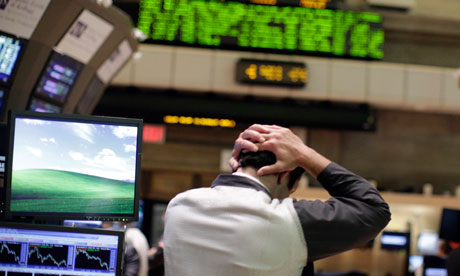
 A trader at the New York stock exchange. The last four years have seen five key stages of the global financial crisis, with more likely to come.
  9 August 2007. 15 September 2008. 2 April 2009. 9 May 2010. 5 August 2011. From sub-prime to downgrade, the five stages of the most serious crisis to hit the global economy since the Great Depression can be found in those dates.
Phase one on 9 August 2007 began with the seizure in the banking system precipitated by BNP Paribas announcing that it was ceasing activity in three hedge funds that specialized in US mortgage debt. This was the moment it became clear that there were tens of trillions of dollars worth of dodgy derivatives swilling round which were worth a lot less than the bankers had previously imagined.
Nobody knew how big the losses were or how great the exposure of individual banks actually was, so trust evaporated overnight and banks stopped doing business with each other.
It took a year for the financial crisis to come to a head but it did so on 15 September 2008 when the US government allowed the investment bank Lehman Brothers to go bankrupt. Up to that point, it had been assumed that governments would always step in to bail out any bank that got into serious trouble: the US had done so by finding a buyer for Bear Stearn while the UK had nationalized Northern Rock.
When Lehman Brothers went down, the notion that all banks were "too big to fail" no longer held true, with the result that every bank was deemed to be risky. Within a month, the threat of a domino effect through the global financial system forced western governments to inject vast sums of capital into their banks to prevent them collapsing. The banks were rescued in the nick of time, but it was too late to prevent the global economy from going into free fall. Credit flows to the private sector were choked off at the same time as consumer and business confidence collapsed. All this came after a period when high oil prices had persuaded central banks that the priority was to keep interest rates high as a bulwark against inflation rather than to cut them in anticipation of the financial crisis spreading to the real economy.
The winter of 2008-09 saw co-ordinates action by the newly formed G20group of developed and developing nations in an attempt to prevent recession turning into a slump. Interest rates were cut to the bone, fiscal stimulus packages of varying sizes announced, and electronic money created through quantitative easing. At the London G20 summit on 2 April 2009, world leaders committed themselves to a $5tn (£3tn) fiscal expansion, an extra $1.1tn of resources to help the International Monetary Fund and other global institutions boost jobs and growth, and to reform of the banks. From this point, when the global economy was on the turn, international co-operation started to disintegrate as individual countries pursued their own agendas.
9 May 2010 marked the point at which the focus of concern switched from the private sector to the public sector. By the time the IMF and theEuropean Union announced they would provide financial help to Greece, the issue was no longer the solvency of banks but the solvency of governments. Budget deficits had ballooned during the recession, mainly as a result of lower tax receipts and higher non-discretionary welfare spending, but also because of the fiscal packages announced in the winter of 2008-09. Greece had unique problems as it covered up the dire state of its public finances and had difficulties in collecting taxes, but other countries started to become nervous about the size of their budget deficits. Austerity became the new watchword, affecting policy decisions in the UK, the eurozone and, most recently in the US, the country that stuck with expansionary fiscal policy the longest.
Last Friday, the morphing of a private debt crisis into a sovereign debt crisis was complete when the rating agency, S&P, waited for Wall Street to shut up shop for the weekend before announcing that America's debt would no longer be classed as top-notch triple A. This could hardly have come at a worse time, and not just because last week saw the biggest sell-off in stock markets since late 2008. Policymakers are confronted with a slowing global economy and a systemic crisis in one of its component parts, Europe. To the extent that they are united, they are united in stupidity, wedded to blanket austerity that will make matters worse not better. And they have yet to tackle the issue that lay behind the 2007 crisis in the first place, the imbalances between the big creditor nations such as China and Germany, and big debtors like the US.
In the circumstances, it is hard to be wildly optimistic about how events will play out. Markets are bound to remain highly jittery, although it seems unlikely that American bond yields will rocket as a result of the S&P downgrade. Japan lost its triple A rating long ago and has national debt well in excess of 200% of GDP but its bond yields remain extremely low. The reason for that is simple: Japan's growth prospects are poor.
So are America's, which is why bond yields will remain low in what is still, for the time being, the world's biggest economy. The dressing down given to Washington by Beijing following the S&P announcement was, however, telling. Growth rates of close to 10% mean that the moment China overtakes the US is getting closer all the time, and the communists in the east now feel bold enough to tell the capitalists in the west how to run their economies. Whatever it means for financial markets this week, 5 August 2011 will be remembered as the day when US hegemony was lost.
All this is terrible news for Barack Obama. He has not delivered economic recovery. The US is drowning in negative equity and foreclosed homes. No president since Roosevelt has won an election with unemployment as high as it is today. Fiscal policy will be tightened over the coming months as tax breaks expire and public spending is cut. The Federal Reserve only has the blunt instrument of QE with which to stimulate the economy, and will only be able to deploy it after a softening up process for the markets that will take several months. On top of that, Obama will now be branded as the president who presided over the national humiliation of a debt downgrade. He looks more like Jimmy Carter than FDR.
Not that the Europeans should get too smug about this, because what we are witnessing is not just the decline of the US but the decline of the west. One response to last week's meltdown was the announcement of talks between the G7 – the US, the UK, Germany, Italy, France, Canada and Japan – but while this would have been appropriate 20 years ago it is not going to calm markets today. Holding a G7 meeting without China today is like expecting the League of Nations without the US to tackle totalitarianism in the 1930s.
There is no happy ending to this story. At best there will be a long period of weak growth and high unemployment as individuals and banks pay down the excessive levels of debt accumulated in the bubble years. At worst, the global economy will be plunged back into recession next year as the US goes backwards and the euro comes apart at the seams. The second, gloomier scenario, looks a lot more likely now than it did a week ago.
Why? Because there is no international co-operation. There are plans for austerity but no plans for growth. Even countries that could borrow money for fiscal stimulus packages reluctant to do so. Europe lacks the political will to force the pace of integration necessary to avoid disintegration of the single currency.
Commodity prices are coming down, but that is the only good news. We are less than halfway through the crisis that began on 9 August 2007. That crisis has just entered a dangerous new phase.